Showing posts with label black scholars. Show all posts

Saturday, September 11, 2010

Prof. Ronald Walters Dies at 72 Years Old

by Dr. Boyce Watkins, Syracuse University 

I woke up today to find that the sun would shine a little bit less brightly than it did the day before. The first email I read was one telling me that Ronald Walters, a noted black Political Scientist at The University of Maryland, had died. He was 72 years old.


Dr. Walters was the director of the African American Leadership Institute. He was also the Campaign Manager for the presidential run of Rev. Jesse Jackson in 1984. I knew Ron as a mentor and friend. He was also on the faculty here at Syracuse University at one point in his career, long before my own. He was one of the most respectable and accomplished black scholars I've ever met, and he was appreciated by nearly everyone. His advice on leadership, activism and black empowerment was second to none.

I reached out to a few friends to get their takes on Professor Walters and many of them were very happy to reply. They were saddened to see the end of Ron's life and career, but most of them understood the urgency of continuing his meaningful work. I haven't been able to catch up with Rev. Jesse Jackson yet, but I'll be on his show Sunday morning. Ron and I have been on Rev. Jackson's show together in the past, and few people were impacted more by Dr. Walters than Rev. Jackson himself.


Click to read.

Tuesday, August 10, 2010

Julianne Malveaux: Five Years After the Levees Broke

BEH cover

On August 29, we will commemorate five years since Hurricane Katrina hit New Orleans, and since subsequently levees broke, drowning the city in feet of water. Five years ago our nation exhibited some of the most profound indifference to human beings as thousands of New Orleaneans were stuck without food, water, or sanitation in the Super Dome. In the aftermath of those five years, those divisions of race and class have determined which individuals have recovered from Katrina and who has not. Five years after the levees broke, the City of New Orleans is still bruised from the tragedy of a natural disaster, a man-made disaster, and an indifferent government.


Click to read.

Saturday, June 19, 2010

What to do about BP?

William Butler Yeats did a good job of capturing a harrowing pandemonium in his poem, The Second Coming. He wrote, in 1919

Things fall apart; the centre cannot hold;

Mere anarchy is loosed upon the world,

The blood-dimmed tide is loosed, and everywhere

The ceremony of innocence is drowned;

The best lack all conviction, while the worst

Are full of passionate intensity.

I was twice introduced to the poem in college, first in a class that required the study of English poets, then in a class that examined African literature, including the powerful novel of Nigerian colonization by Chinua Achebe, ironically titled, Things Fall Apart. The poem is so emblazoned on my brain that from time to time it comes to mind, most recently when I contemplate the BP oil spill, its damages, its consequences, and its handling.

I am writing from the Rainbow/PUSH Coalition Conference, 55 days after the Deepwater Horizon explosion that killed 11 people and started an oil leak that apparently continues. While BP says that the leak was only 5000 barrels of oil a day, scientists estimate that between 20,000 and 40,000 barrels of oil leaked each day between April 22 until June 3. If you use the midpoint of 30,000 barrels and a period of 42 days (assuming all leaking stopped when a dome to catch some of the leak was installed on June 3), we are talking at least 1.2 million barrels of an oil leak.

Click to read


Wednesday, June 9, 2010

Barack Obama an "Angry Black Man?"

Visit our Other Blogs and Join Our Family!

African American News

Black Celebrity News

Syracuse University

Your Black World

Black Scholars Blog

Black Political Blog

Black News Blog

Scholarship in Action at Syracuse University

clip_image002[3]

Follow us on Twitter!


Wednesday, January 13, 2010

Michael Eric Dyson Puts the Hammer on Obama

3e351d51a5a75-31-1

Michael Eric Dyson, professor of African American studies at Georgetown, addressed the Harry Reid “negro dialect” controversy last night on MSNBC.  He criticized Obama for avoiding racial issue.

You ain’t talking about civil rights, you ain’t talking bout affirmative action, you’re not pressing the issue.”

He also said that Barack Obama does not sound Black.

If Barack Obama was standing forth in America to speak brilliantly and courageously about the issues of race, he’d sound a lot more black too.

Click to read.

Wednesday, September 16, 2009

Christopher Metzler: Is the Obama Presidency in Trouble?

metzler

By Christopher Metzler

President Obama’s presidency is in peril for two primary reasons. The first, his inability to be a transformational leader to an American public hungry for it is of his own making. The second, the thinly veiled demonstration of racism unskillfully disguised as “concern for country” is both to be expected and not of his own making. 

First, President Obama came into to office promising “change that we can believe in.” However, on the signature issue of change, health care reform, he has not led; choosing instead to send a litany of mixed messages as to whether  he would turn the Byzantine labyrinth that is the American health care system on its head. A transformational leader takes bold, decisive, innovative action if he or she believes that it is right for the country. Thus far, on health care, the President has not demonstrated transformational leadership; he has pledged fidelity to the status quo.

Click to read more.

Thursday, September 10, 2009

On with Leon: A Conversation about the Economy


image

Dr. Wilmer Leon Speaks to Dr Danny Boston, an Economist at Georgia Tech University about the state of the economy.  Click here to listen!

Wednesday, September 9, 2009

The 5 Lowest Paid Majors in College

by Dr. Boyce Watkins, Syracuse University 

According to the "College Majors Handbook," the 5 lowest paying college majors are Social Work, Special Education, Elementary Education, Home Economics and Music/Dance. As a college professor for the past 16 years, I was only surprised that other "interesting" majors were not on the list, such as Philosophy or Anthropology. In a recent NPR interview, I spoke on the value of going to college and whether or not it's worth the expense. The answer to this question is very simple: It depends.

Here are some things to remember when choosing a major for yourself or your children in college:

1) Know what you are getting. Don't major in a low paying major expecting to make the same money as business school students. It's simply not going to happen. Pick a major with the salary expectations that make you comfortable. Money doesn't have to be important to you, just make sure you're honest with yourself about how important money actually is.

2) Make sure that your major can help you repay your student loans. Most young people who went to college are going to die in debt. Don't let yourself become one of those people.

Click to read.

Sunday, September 6, 2009

Howard University Students Get Support for their Protests

by Dr. Boyce Watkins, Syracuse University

Howard University has a problem. Apparently, the school's students have taken lessons on freedom of speech to heart and actually believe they have a voice in running the campus. That problem is magnified by the fact that they are finally speaking up on issues of mismanagement and incompetence that plague many universities around the nation, particularly Historically Black Colleges and Universities.

We all know that HBCUs can be amazing places to get an education. But we also know that many HBCUs are as slow as molasses when it comes to adopting the necessary administrative adjustments to keep up with the demands of college students. We also know that many HBCUs are not even hiring very many black professors, particularly in business and the sciences (Howard University is one of them). Not having the funds to engage in sound administrative policy is almost understandable. But ignoring calls for appropriate change because it undermines your quest to maintain power....well, that just makes you a black version of the Bush Administration.

Click to read.

Tuesday, August 4, 2009

Harvard Gates Is Part-Irish


Henry Louis Gates Jr., the black professor at the center of the racial story involving his arrest outside his Harvard University-owned house, has spoken proudly of his Irish roots.

Strangely enough, he and the Cambridge, Mass., police officer who arrested him, Sgt. James Crowley, both trace their ancestry back to the legendary Niall of the Nine Hostages.

In a PBS series on African-American ancestry that he hosted in 2008, Gates discovered his Irish roots when he found he was descended from an Irish immigrant and a slave girl.

click here to read more

Saturday, August 1, 2009

Syracuse University Professor: College Athletes Should Be Paid


The NCAA, which is a nonprofit, tax-exempt 'educational' organization, has come under fire recently for capitalizing on the commercialization of college sports. Many athletes have accused the organization of unfairly using them for financial gain.

Since 1995, the NCAA has spent more than $84 million on legal fees, including some settlements. Former UCLA basketball star Ed O'Bannon filed a lawsuit on July 21 against the NCAA and its member schools, accusing them of illegally profiting from using the likeness of former players for commercial pursuits like video games, DVDs, and jersey sales.

Dr. Boyce Watkins, a finance professor at Syracuse University, has become a vocal critic of the NCAA, for what he calls its exploitation of the black community.

click here to read more

Professor Gates Plans To Meet With Officer Again


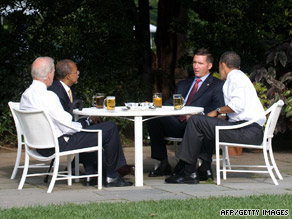
WASHINGTON (CNN) -- The officer who arrested a top African-American professor said talks over beers Thursday evening at the White House were productive and the two men plan to meet again.

Sgt. James Crowley and Henry Louis Gates Jr. sat around a patio table with President Obama and Vice President Biden, drank beer, munched on snacks and talked about the arrest that has sparked debate about racial profiling and police procedures.

"It was a private discussion. It was a frank discussion," Crowley said of the meeting, but would not divulge specifics except to say that no one apologized.

click here to read more

Friday, July 31, 2009

A Beer for Race

When it comes to race, we could all use a drink

You can make fun of me for being a goody two shoes, but I've never finished a beer in my entire life. I am, however, willing to drink a beer with President Obama if that will open the door to an honest conversation on race relations in America.

President Obama's announcement that he will get together today with Dr. Henry Louis Gates and Sgt. James Crowley for a beer sounds, honestly, like a bit of political posturing from a man who is trying to reverse the stain of tremendous embarrassment. But like a political pro, the president is getting chummy with police departments across the nation, and this will help him recover from his own "George Bush moment," in which he attacked the Cambridge Police Department while admittedly not knowing all the facts.

Perhaps the first beer in the White House will turn into a second and a third. People let it all hang out when they get drunk, so maybe open bottles of beer will encourage the three parties involved to have an honest dialogue on race. In fact, why don't the rest of us drink a beer too? The American racial conversation should not only include three people behind closed doors, it should include all of us.


Click here to read more

Thursday, July 30, 2009

Glenn Beck Thinks Obama Is A Racist


NEW YORK (AP) — Fox News Channel commentator Glenn Beck said he believes President Obama is a racist. Beck made the statement during a guest appearance Tuesday on the Fox & Friends morning show. He said Obama has exposed himself as a person with "a deep-seated hatred for white people or the white culture."

His remarks came during a discussion of Obama's reaction to the arrest of Harvard University scholar Henry Louis Gates Jr. Gates is black and was arrested for disorderly conduct by a white policeman over a misunderstanding about a break-in at Gates' home.

An Obama spokesman, William Burton, said the White House had no comment on Beck.

Beck's statement was challenged on the air by Fox host Brian Kilmeade, who noted that most of the people who work for the nation's first black president are white.

click to read more

Scholar Yells Racism

henry gates

By ISHMAEL REED

Now that Henry Louis Gates’ Jr. has gotten a tiny taste of what “the underclass” undergo each day, do you think that he will go easier on them? Lighten up on the tough love lectures? Even during his encounter with the police, he was given some slack. If a black man in an inner city neighborhood had hesitated to identify himself, or given the police some lip, the police would have called SWAT. When Oscar Grant, an apprentice butcher, talked back to a BART policeman in Oakland , he was shot!

Given the position that Gates has pronounced since the late eighties, if I had been the arresting officer and post-race spokesperson Gates accused me of racism, I would have given him a sample of his own medicine. I would have replied that “race is a social construct”--the line that he and his friends have been pushing over the last couple of decades.

After this experience, will Gates stop attributing the problems of those inner city dwellers to the behavior of “thirty five-year-old grandmothers living in the projects?” (Gates says that when he became a tough lover he was following the example of his mentor Nobel Laureate Wole Soyinka as though his and Soyinka’s situations were the same. As a result of Soyinka’s criticisms of a Nigerian dictator, he was jailed and his life constantly threatened.)

Prior to the late eighties, Gates’ tough love exhortations were aimed at racism in the halls of academe, but then he signed on to downtown feminist reasoning that racism was a black male problem. Karen Durbin, who hired him to write for The Village Voice, takes credit for inventing him as a “public intellectual.” He was then assigned by Rebecca Penny Sinkler, former editor of The New York Times Book Review, to do a snuff job on black male writers. In an extraordinary review, he seemed to conclude that black women writers were good, not because of their merit, but because black male writers were bad. This was a response to an article by Mel Watkins, a former book review editor, who on his way out warned of a growing trend that was exciting the publisher’s cash registers. Books that I would describe as high Harlequin romances, melodramas in which saintly women were besieged by cruel black male oppressors, the kind of image of the brothers promoted by confederate novelists Thomas Nelson Page and Thomas Dixon.

Click here to read more

Wednesday, July 29, 2009

The Ways Companies Make Money off Prisoners


Dr. Byron Price is a black scholar with a mission. His book, "Merchandizing Prisoners" opens the door for a discussion on how the African American community is being financially pillaged by the prison industry. You may not know this, but private corporations earn money from inmate incarceration and have a direct financial incentive to house more inmates. This is a problem, since unfocused profit maximization does not make room for the dual-significance of social progress. Dr. Price is one of the leading scholars in America and he has taken it upon himself to help solve this problem.

1) What is your name and what do you do for a living?
Byron E. Price, Associate Professor, Political Science Department and Interim Director, Barbara Jordan Institute for Policy Research
2) Tell us about your book? What does it teach us?
According to National Union of Public and General Employees, "This book examines the steady growth of private, for-profit prison firms and the correctional-commercial complex that has developed tangentially with the private prison industry. It also details the strange bedfellows that have been brought together to expand this industry.

I underscore how these for-profit private prison companies have gone public and are trading on the stock exchanges and the inimical impact of prisons being publicly traded. The book debunks many of the claims as to why states seek prison privatization and demonstrates that incarceration is the new form of slavery....This work sets the record straight about the decision to privatize state prisons, revealing the political bias that often drives these policy choices."

Click here to read more